Premium accessories for iPhone 18. Shop now

Charging
Does the iPhone 18 Need a New Charger?
What changes for the iPhone 18 Pro and Pro Max, and which of your chargers carry over.
No. The port has not changed, your magnetic chargers still snap on, and the speed ceiling moved last year rather than this one. There is one upgrade worth making, and it costs less than replacing a charger.

About the brand

Belkin has made phone and laptop accessories since 1983: chargers, power banks, docks and screen protection. Every product is tested in our own labs and backed by a warranty and real support.
Shop BelkinGet 15% off
New gear, plain answers, and the occasional deal. Blog alerts, product announcements and exclusive offers by email and text.
Sign upEmails and texts. Unsubscribe anytime.
Key takeaways
- Your existing chargers keep working. The port is still USB-C, and magnetic chargers built for iPhone 12 and later still snap on.
- The speed ceiling rose with the iPhone 17 generation, which already reaches 40W wired and 25W wireless.
- A wattage rating is the most a part can carry, and the wall adapter behind your charger usually sets what you actually get.
- Batteries are getting bigger, so a higher-wattage wall adapter does more for you this year than a new cable.
Every iPhone launch sends people digging through a drawer of cables to work out what still fits. Charging has changed less than any other part of the iPhone. The port has not changed since the iPhone 15, the magnets have not changed since the iPhone 12, and the wall adapter you bought two years ago still fills the battery. The few things that did change are what decide how fast your phone charges.
What Carries Over from Your Current Setup
Three things stayed put, and they cover most of what people already own.
- The port is still USB-C. Apple moved the iPhone to USB-C with the iPhone 15 and has kept it since, so your cables plug in.
- The magnets are still there. MagSafe and Qi2 both snap a ring of magnets into alignment over the charging coil, which is what makes magnetic charging steadier than a flat pad. Chargers built for iPhone 12 and later still attach.
- There is still no charger in the box. Apple stopped including a wall adapter in 2020. A new iPhone comes with a cable, and the adapter is yours to supply.
The speed jump most people are waiting for already happened. The iPhone 17 generation supports up to 40W over USB-C and up to 25W wireless on a Qi2 25W charger. Expectations for this year's models sit at those same figures, so a charger bought for an iPhone 17 already delivers everything the new phone can accept.
What a Wattage Number Promises
A 60W cable does not charge your phone at 60W. It carries up to 60W, if the adapter behind it supplies that much and the phone asks for it. Your phone draws only what it is built to draw, and whichever part of the chain has the lowest limit sets the speed.
People often ask whether a 15W Qi2 charger is good enough for a new iPhone, and how it stacks up against a 60W cable. The two numbers are not measuring the same thing. The 15W is a wireless ceiling. The 60W is what the cable could carry, and your phone will never ask for that much, because it tops out around 40W wired. A 15W magnetic charger is a fine nightstand choice, and a wired connection with a 40W-capable adapter is faster than any wireless option.
Swipe the table sideways to see every column.
| Tier | How it connects | What it suits |
|---|---|---|
| 5W to 7.5W | Flat Qi pad | Overnight top-ups where speed does not matter |
| 15W | Qi2 magnetic | Everyday magnetic charging on a nightstand or desk |
| 25W | Qi2 25W magnetic | The fastest wireless charging available |
| 20W | USB-C wired | Baseline fast charging |
| 40W | USB-C wired | The fastest wired charging recent iPhones accept |
Qi2 25W Raises the Wireless Ceiling to 25W
Qi2 25W, also called Qi2.2, lifts the wireless ceiling from 15W to 25W. It uses a stronger set of magnets that hold the phone in a tighter position and keep it cooler, so the charger can hold that higher speed instead of easing off after a few minutes.
Alignment does most of the work. A coil sitting slightly off center wastes energy as heat, and magnets remove that variable entirely. Two things to check when you shop:
- It is backward compatible. A Qi2 25W charger still powers older Qi2 phones at 15W, so what you buy now works with the phone in your pocket today and the one you upgrade to later.
- It needs a real adapter behind it. Reaching 25W takes a 30W or higher USB-C wall adapter. Paired with a 20W adapter, a 25W charger delivers 20W at best.
As for MagSafe versus Qi2, in everyday use they behave the same way. MagSafe is Apple's implementation, and Qi2 is the open standard that brought the same magnetic alignment to Android and iPhone alike.
A Folding iPhone Changes What a Charger Has to Hold
Apple is expected to introduce a foldable this year, positioned above the Pro models. For charging, the open question is whether the magnets survive the redesign.
The expectation is that they do. Fitting a charging coil into a body that folds is the harder engineering problem, and Apple has not shown the result.
If that holds, magnetic chargers, stands, and battery packs that people already own attach to it. What changes is how you position it, because a folding phone has two usable shapes. A stand that holds it open becomes more useful than it was on a slab phone, and so does a magnetic power bank that stays attached while the phone is folded shut.
Bigger Batteries Make Your Wall Adapter Matter More
Battery capacities have surfaced through regulatory filings.
Swipe the table sideways to see every column.
| Model | Reported capacity | Change |
|---|---|---|
| iPhone 18 Pro | About 4,288 mAh (US) | Up under 2% |
| iPhone 18 Pro Max | 5,567 mAh eSIM, 5,391 mAh with SIM tray | Up 479 mAh to 568 mAh |
| Foldable | About 4,883 mAh across two cells | New form factor |
Capacities are from regulatory filings reported before launch, not from Apple, which publishes battery life in hours rather than milliamp-hours. Figures are rounded and may differ by region.
If these hold, the Pro Max carries the largest battery Apple has shipped in an iPhone, and eSIM-only models gain capacity because removing the SIM tray frees interior space.
A larger battery takes longer to fill at the same wattage, so the 20W brick that felt adequate for a smaller battery now leaves you waiting noticeably longer.
Which Charger Fits Where You Charge
The four picks below are grouped by where you charge.
How we picked: we chose one charger for each of the four places people charge most, weighing alignment, wattage, and how many devices each one handles. The three wireless chargers are Qi2 25W, and all four are tested for safe power delivery.
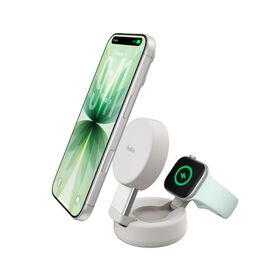
Best for the desk
2-in-1 Convertible Magnetic Charger with Qi2 25W
- Qi2 25W
- Phone + watch
- Upright stand
- Screen stays visible
- Snap-on alignment
- Charges a watch too
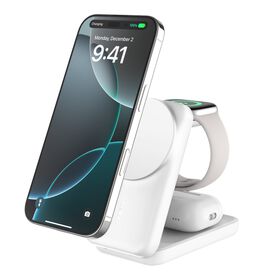
Best for travel
3-in-1 Foldable Magnetic Charger with Qi2 25W
- Qi2 25W
- Three devices
- Folds flat
- Phone, watch and buds at once
- Packs into a bag
- Full 25W speed
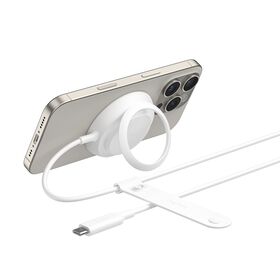
Best for the nightstand
- Qi2 25W
- Compact
- Case-friendly
- Holds position overnight
- Small footprint
- Charges through cases
Best for away from a plug
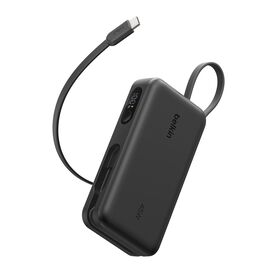
Power Bank 10K with Integrated Cable and Display
- 10,000 mAh
- Built-in cable
- Battery display
- No extra cable to carry
- Shows exact percentage
- Covers a full day out
If you buy one thing this year, make it a 30W or higher USB-C wall adapter. It lifts the ceiling on every charger you already own, and it costs less than replacing them.
New from Belkin for the iPhone 18 Season
Belkin's fall charging line lands in the weeks around the keynote, and four of the new arrivals answer the questions above directly: a power bank that snaps to the back of the phone, a bigger one that also fast-charges a laptop, and two Qi2 25W docks that hold a phone at full wireless speed. The two power banks use a semi-solid BoostSolid cell, the subject of our explainer on how long power banks last.
New: BoostSolid cell

Coming Sep 16
Slim Magnetic Power Bank 5K with BoostSolid Cell
- 5,000 mAh
- 15W Qi2 magnetic
- 22.5W USB-C
- Snaps to the back of the phone
- Up to 3x lifespan
- About one full charge
$69.99Coming soon
New: BoostSolid cell

Coming Sep 16
Power Bank 10K with BoostSolid Cell
- 10,000 mAh
- 60W USB-C
- 3 ports
- Fast-charges a laptop too
- Up to 3x lifespan
- Display shows charging status
$89.99Coming soon
Qi2 25W dock
In stock
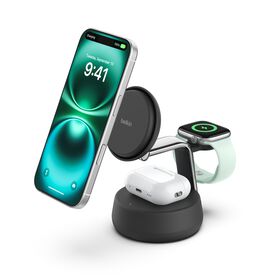
3-in-1 Magnetic Charging Dock with Qi2 25W
- Qi2.2 25W certified
- Phone, watch, earbuds
- 45W adapter included
- Built-in fan keeps the phone cool
- Charges all three at once
- Cable and power supply in the box
$129.99Shop
Qi2 25W dock
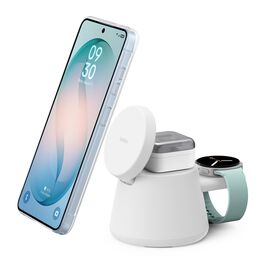
In stock
Modular Charging Dock with Qi2 25W
- Qi2.2 certified
- Modular base
- 45W adapter included
- Several devices from one base
- Small footprint
- Cable and power supply in the box
$64.99Shop
Later this month Belkin adds a 67W dual USB-C GaN wall charger and UltraCharge power banks with a built-in retractable cable. Neither is on sale yet, so they are not linked here.
Why trust Belkin
Belkin has built charging accessories since 1983 and is a certified Qi2 and MagSafe partner. Every charger is tested before it ships. It has to deliver power safely, stay within a safe temperature, and notice a coin or key caught between the phone and the pad.
iPhone 18 Charging: Your Questions Answered
Does my old MagSafe charger work with the new iPhone?
Yes. Magnetic chargers built for iPhone 12 and later still attach and charge. A 15W charger charges at 15W rather than the newer 25W tier, so you keep the convenience and give up some speed.
Is a 15W wireless charger good enough for an iPhone 18 Pro?
For a nightstand or a desk, yes. For the fastest possible charge, a Qi2 25W charger paired with a 30W adapter is quicker, and a wired connection is quicker still. Most people charging overnight will not notice the difference.
Does a 60W cable charge my phone faster than a 40W one?
No. The phone draws what it is designed to draw, which is around 40W wired on recent models. A higher-rated cable gives you headroom for laptops and tablets rather than more speed for a phone.
Do I need a new cable for the new iPhone?
Probably not. USB-C to USB-C cables carry over. If you want the fastest wired speeds, check that the cable is rated for the wattage you are after, because thin or older cables cap lower than you might expect.
Does the new iPhone come with a charger?
No. Apple has not included a wall adapter in the box since 2020. You get a cable, and the USB-C adapter is a separate purchase.
Will my magnetic accessories work with the foldable iPhone?
Reporting says the foldable includes MagSafe, which would mean existing magnetic chargers, stands, and mounts attach to it. Apple has not confirmed this, so treat it as expected rather than settled.
Why does my phone charge slower than the charger's rating?
Usually the wall adapter behind it, since a 20W adapter caps a 25W charger. Heat matters too, because phones slow charging to protect the battery when they get warm, and so does battery level, since the last 20% always fills more slowly than the first.
Charging Essentials
The chargers and power banks that pair with a new iPhone.
Wireless charger
2-in-1 Convertible Magnetic Charger with Qi2 25W
$99.99Shop
Wireless charger
3-in-1 Foldable Magnetic Charger with Qi2 25W
$99.99Shop
Wireless charger
Magnetic Charger with Qi2 25W
$39.99Shop
Power bank
Power Bank 10K with Integrated Cable and Display
$44.99Shop
Wall charger
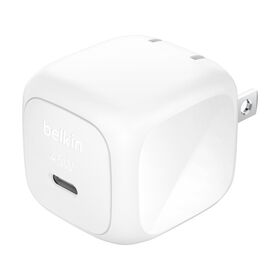
Compact USB-C Wall Charger 45W
$19.99Shop