Premium accessories for iPhone 18. Shop now

Power & Charging
How Long Do Power Banks Last? Belkin Built Technology that Changes the Answer
Meet the Semi-Solid Power Bank, Your New Mobile Charging Device Companion
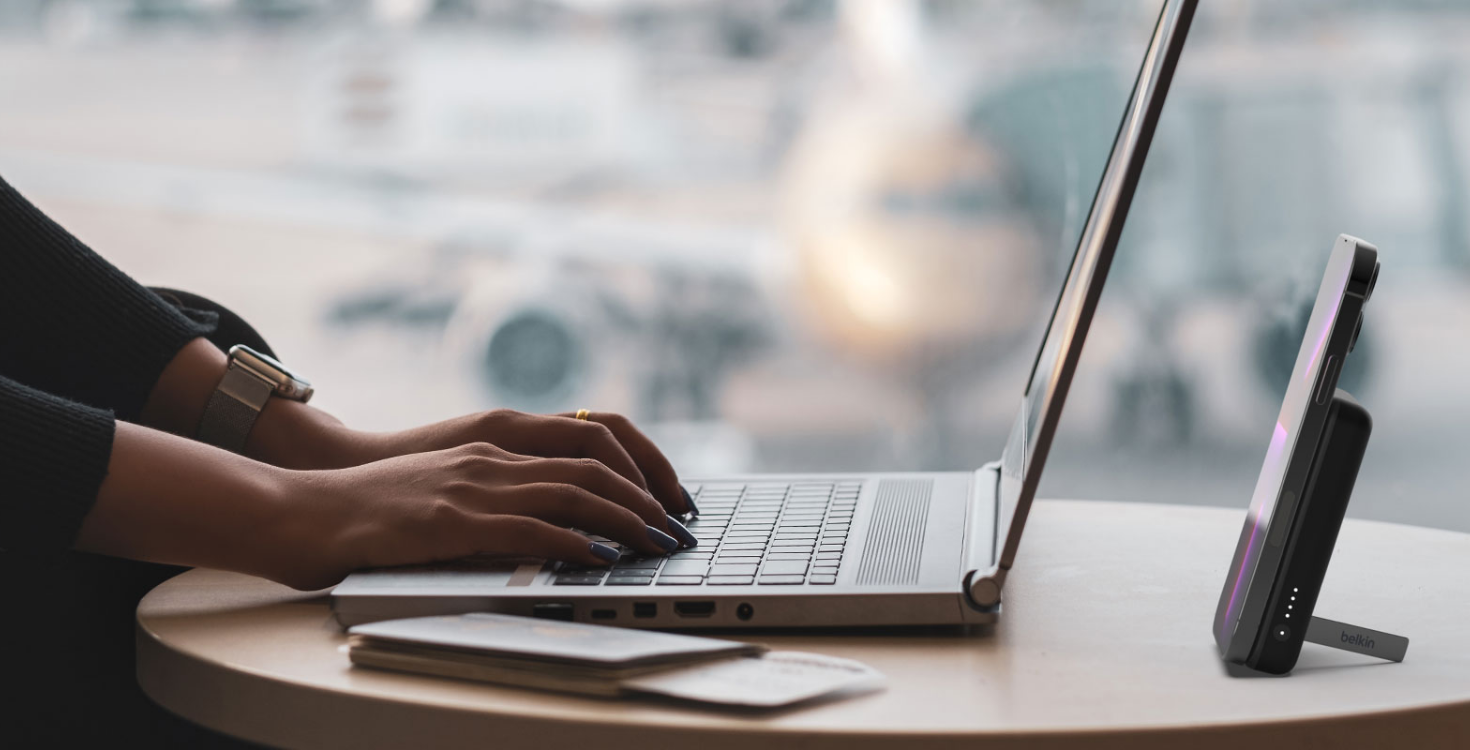
Some heavily used power banks can show noticeable capacity loss in under two years. Belkin's semi-solid BoostSolid cell holds at least 80% of its capacity past 1,000 charges, keeps delivering power in a freezing car or a hot glovebox, and still slips into your pocket. UltraCharge Pro is available to order now.
On this page
About the brand

Belkin has made phone and laptop accessories since 1983: chargers, power banks, docks and screen protection. Every product is tested in our own labs and backed by a warranty and real support.
Shop BelkinGet 15% off
Subscribe for blog alerts, product announcements and exclusive deals, by email and text.
Sign upEmails and texts. Unsubscribe anytime.
Key takeaways
- Belkin's BoostSolid cell lasts about three times longer: more than 1,000 charges while holding at least 80% of its capacity, against 300 to 500 for a standard cell. That is roughly five years of regular use.
- It fits the same power into less space: the 10,000 mAh pack is 27% smaller than a standard 10K power bank at 14.5 mm thick, and the 5,000 mAh pack is 8.8 mm, thinner than most phone cases.
- It keeps delivering power from 14°F to 140°F, through a freezing morning or a hot glovebox. Recharge the pack itself between 32°F and 104°F.
- Two models are available to order now: the Slim Magnetic 5K for everyday carry, and the 10K 60W for travel, laptops, and charging several devices at once.
A power bank rarely dies in a dramatic way. It fades. Most packs manage 300 to 500 charges before they start to slip, and if you top one up every other day, that is under two years. Nothing breaks outright. The pack that used to refill your phone in one go now leaves you at two-thirds, usually on the afternoon you were counting on it. Belkin built a cell that holds up about three times longer, in the same size that already fits your pocket.
What Makes UltraCharge Pro Last Longer
Standard power banks run on a liquid electrolyte. The solid-liquid hybrid electrolyte system is designed to improve cell stability and cycle life. At the product level, Belkin combines the cell with dual-chip monitoring, structural protection and thermal-management features. It is an evolution of the lithium-ion battery Belkin already builds on, not a rip-and-replace, and three things change because of it.
- It lasts about three times longer. The cell is rated past 1,000 charges before it drops below 80% of its original capacity, where a standard cell taps out at 300 to 500. For most people that is around five years of everyday use instead of eighteen months to two.
- It fits the same power into less space, 27% smaller than a standard 10K power bank. A full 10,000 mAh ends up 14.5 mm thick, and 5,000 mAh comes in at 8.8 mm.
- It keeps delivering in heat and cold that sideline an ordinary battery, rated to power your devices from 14°F to 140°F. Recharging the pack itself is a gentler ask, best kept between 32°F and 104°F, the range most lithium electronics prefer.
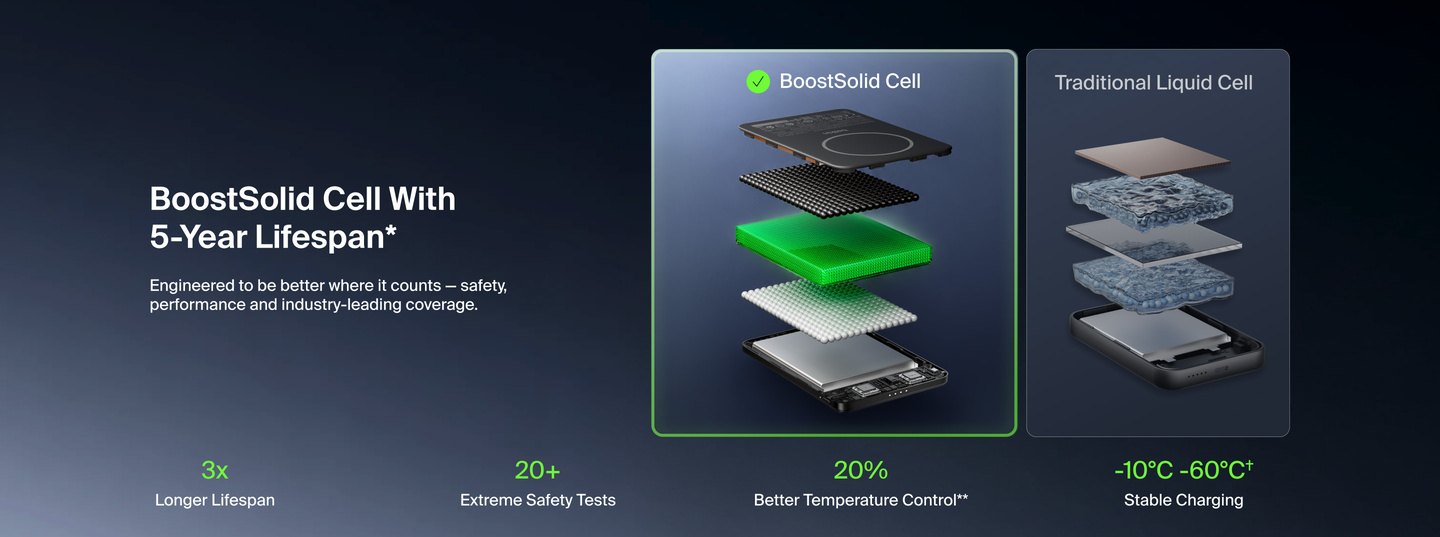
* Based on cycle life comparison. Retains up to 80% capacity after 1,000 charge cycles; estimated 5-year lifespan assumes one full charge/discharge cycle every two days. Actual performance may vary. ** Based on internal testing. Results may vary depending on numerous factors. † Delivers power from 14°F to 140°F (-10°C to 60°C); recharge the pack between 32°F and 104°F (0°C to 40°C).
Is a Semi-Solid Power Bank Safe?
BoostSolid does not throw out the lithium-ion chemistry Belkin has shipped for years. It builds on it. The gel-like layer buys extra stability under stress, a longer usable life, and room to shrink the pack without shrinking the capacity.
Around the cell sits Belkin SmartProtect, a hardware safety system. Two independent chips track temperature in real time, and either one can cut power on its own, so a single fault does not take down the whole pack. A structural layer adds a swelling buffer and an impact-resistant frame, and active heat dissipation carries heat away from the cell instead of letting it pool.
Belkin ran the cell through crush, drop, and vibration tests, and drove a steel nail through the center of it with the pack switched off. The result was no fire, no explosion, and no thermal runaway. That is not a promise that a battery can survive anything. Every pack, semi-solid or liquid, should be kept away from punctures and extreme heat.
Why trust Belkin
Belkin has made charging accessories since 1983 and tests every cell in its own labs. UltraCharge Pro ships with SmartProtect built in, a warranty, and real support behind it.
The Two UltraCharge Pro Power Banks
Two models are available to order now, and the BoostSolid cell sits inside both. One is built to disappear into a pocket. The other is built to run a weekend.
Swipe the table sideways to see both models.
| Specification | Slim Magnetic 5K | 10K 60W |
|---|---|---|
| Capacity | 5,000 mAh | 10,000 mAh |
| Thickness | 8.8 mm | 14.5 mm |
| Wireless | 15W Qi2 magnetic | Not supported |
| Wired | Up to 22.5W USB-C | Up to 60W USB-C |
| Ports | 1 USB-C | 2 USB-C, 1 USB-A |
| Smart display | Not supported | Battery level and power info |
| Warranty | 2 years | 2 years |
Everyday carry

Available now
UltraCharge Pro Slim Magnetic 5K
- 5,000 mAh
- 8.8 mm slim
- 15W Qi2 magnetic
- Sticks to your iPhone
- Charges wirelessly, no cable
- About one full charge
$69.99Shop
Travel and multi-device
Available now
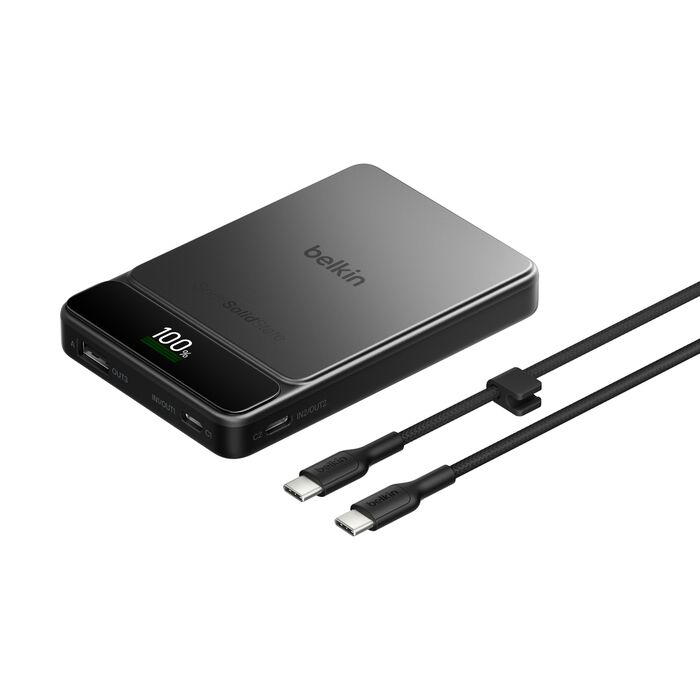
UltraCharge Pro 10K 60W
- 10,000 mAh
- 27% smaller design
- 60W USB-C
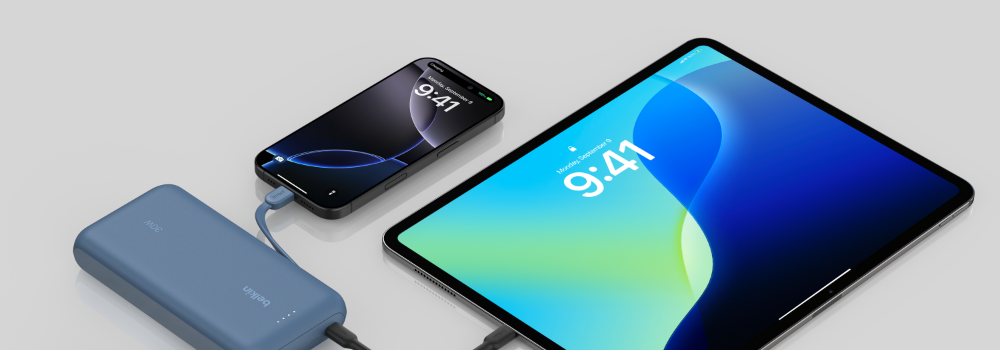
- Charges three at once
- 60W for tablets and laptops
- Smart display shows battery level
$89.99Shop
Where a Better Battery Helps
The specs matter because of where they land in a normal day. Here is what the extra lifespan, the slimmer body, and the wider temperature range change in practice.
Everyday Carry
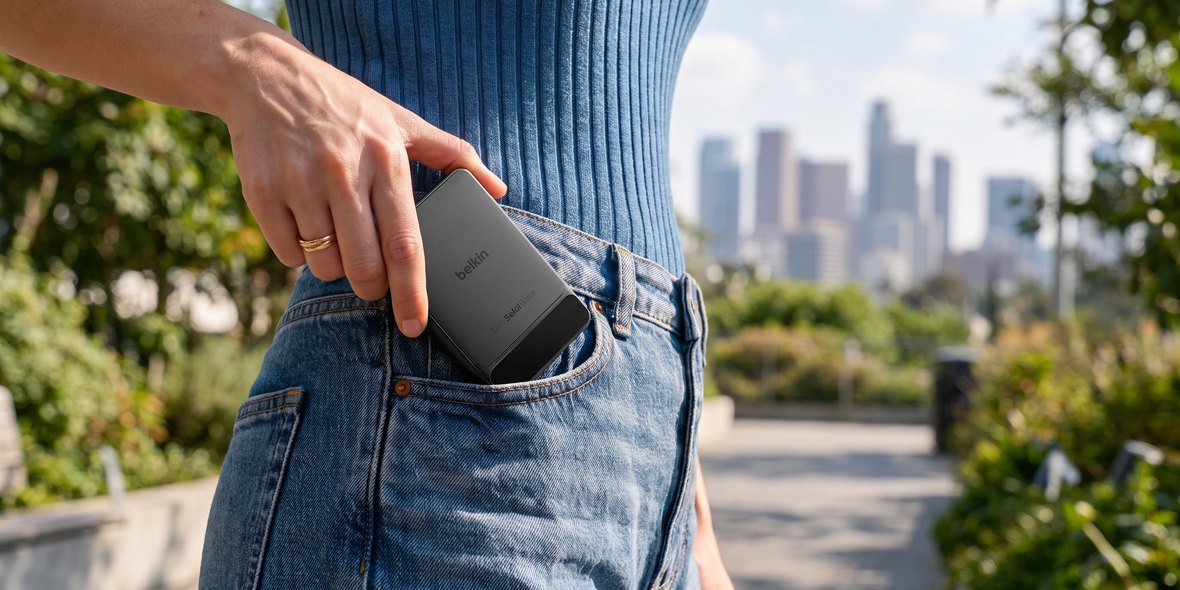
At 8.8 mm, the 5K is thinner than most phone cases. It snaps magnetically onto the back of an iPhone and charges wirelessly while you keep using the phone, so you can take a call or answer a message with the pack still on the back. Phone and pack together fit in a jacket pocket, which is usually what decides whether a power bank gets carried every day or left in a drawer. This one holds about a full charge.
Does a Power Bank Work in the Cold?
Cold is where liquid cells give up first. Anyone who has tried to use a phone on a ski lift knows the feeling: the battery drains fast and the phone can shut off well before it reads 0%. Power banks behave the same way. At 14°F, UltraCharge Pro tests with about 7 percentage points more usable capacity than a standard cell, 77.3% against 69.9%, so it keeps delivering on a freezing chairlift or a cold morning instead of trailing off early. Recharging the pack itself is best done between about 32°F and 104°F, the same guidance as most lithium electronics.
Can You Leave a Power Bank in a Hot Car?
It is rated to run your devices up to 140°F, so it can stay in the car between stops on a road trip. A 2018 study from Arizona State University and UC San Diego found cabin air in cars parked in summer sun averaged 116°F within an hour, so a warm glovebox stays inside its range. One limit applies to every power bank, though: in that same study, dashboards in direct sun averaged 157°F, past what any consumer battery can handle. Keep it in the glovebox, console or a door pocket instead.
Travel Days and Airports
A long travel day puts the phone to work on boarding passes, maps, translation and photos from early morning to late evening. The 5K handles that on its own, without a cable, and fits in a passport pocket. The 10K covers a travel day for two people, or for one person carrying a tablet as well.
Camping and Weekends Outdoors
The 10K charges three devices at once, across two USB-C ports and one USB-A, enough for a full weekend away from an outlet. That is two days of phone use with capacity left over for a watch and a set of headphones, and the smart display shows the exact percentage remaining rather than four LEDs that leave you guessing. Its heat tolerance also means it can live in the car or the bottom of a bag without much thought.
Long Trips and Handheld Gaming
A Switch 2 takes roughly a full charge from the 10K, or several top-ups across a long flight or drive. A Kindle recharges about fourteen times from a single pack, which covers any trip you are likely to take.
Working Away from a Plug
The 10K's 60W USB-C port charges a tablet at full speed instead of slowly losing ground while you use it. An iPad Pro takes a substantial top-up, and a MacBook Air charges well from it too. Add a phone and earbuds alongside and it charges all three at once.
How Many Charges Do You Get from a Power Bank?
About two thirds of the number printed on the box. A 10,000 mAh pack behaves like roughly 6,500 mAh by the time the power reaches your phone. Energy turns to heat every time it moves from one battery to another, which is why your phone warms up while it charges. That is true of every power bank on the market, including these, so a 10,000 mAh pack will not fill a 5,000 mAh phone twice. The quick version: take the number on the box and subtract a third.
Swipe the table sideways to see both models.
| Device | 5K | 10K |
|---|---|---|
| iPhone 17 Pro Max | About 0.7 charges | About 1.4 charges |
| iPhone 17, iPhone 16 | About 0.9 charges | About 1.7 charges |
| iPhone Air | About 1 charge | About 2 charges |
| Galaxy S25 Ultra | About 0.6 charges | About 1.3 charges |
| Pixel 10 | About 0.7 charges | About 1.3 charges |
| Nintendo Switch 2 | About 0.6 charges | About 1.2 charges |
| iPad Air 11 inch M3 | About 0.4 charges | About 0.8 charges |
| Apple Watch Ultra 3 | About 5 charges | About 10 charges |
| AirPods Pro 3 case | About 9 charges | About 18 charges |
| Kindle Paperwhite | About 7 charges | About 14 charges |
These are approximate and vary with cable, charging speed and temperature.
How Many Years Will a Power Bank Last?
About five years of regular use, against two to three from a conventional pack. It comes down to charge cycles. The BoostSolid cell is rated past 1,000 while holding at least 80% of its capacity, where conventional lithium-ion manages 300 to 500. Belkin's five-year estimate assumes about one full cycle every three days. Charge it more often and you reach that count sooner; less often and it lasts longer.
Eighty percent is the industry line for end of useful life. Nothing stops working there, but the pack holds noticeably less than it did when new.
Batteries also age on a clock whether you use them or not. Heat drives most of it, and so does sitting at a full charge for months. If you are storing a pack for more than a few weeks, leave it around half charged and keep it somewhere at room temperature.
Can You Bring a Power Bank on a Plane in 2026?
Both models are cleared for carry-on on any airline, with no approval needed. Airlines rate power banks by watt-hours, the limit is 100 Wh, and both sit well under it.
Swipe the table sideways to see the full row.
| Pack | Watt-hours | Status |
|---|---|---|
| UltraCharge Pro 5K | 18.5 Wh | Cleared, 18% of the limit |
| UltraCharge Pro 10K | 37 Wh | Cleared, 37% of the limit |
| The limit | 100 Wh | About 27,500 mAh |
Two rules apply to everyone, whatever the capacity. Power banks are carry-on only, never checked baggage. If your bag gets gate-checked when the overhead bins fill, take the power bank out and keep it with you.
The rules have also tightened. Southwest went first on 28 May 2025, requiring power banks to stay in plain sight while in use rather than tucked in a bag or overhead bin. American and Delta followed on 1 May 2026, capping passengers at two chargers of 100 Wh or less, requiring them to stay visible and within reach, and banning charging in flight. These policies have changed three times in under two years, so check with the airline operating your flight before you go. On a codeshare, that is often not the airline you booked with.
Which One Should You Buy?
It comes down to how you spend your day.
The UltraCharge Pro Slim Magnetic 5K is for days that run on a phone. It snaps onto the back of an iPhone, sits in a pocket at 8.8 mm, and holds about one full charge. Pick it if you want a power bank you carry by default rather than pack on purpose.
The UltraCharge Pro 10K 60W is for travel, laptops, and charging several things at once. Three devices together, 60W over USB-C, a display that shows the exact percentage left, and enough capacity for a weekend rather than an afternoon.
Whichever you choose, the cell inside is the same. Both are rated past 1,000 charges at 80% capacity, both power your devices from 14°F to 140°F, and both sit well inside airline carry-on limits. Either way, you stop thinking about the battery, which is what a good one is for.
Power Banks: Your Questions Answered
How long do power banks typically last?
Most conventional power banks last two to three years, or about 300 to 500 full charge cycles, before capacity drops below 80% of what it was new. Belkin's BoostSolid cell is rated past 1,000 cycles at that same 80% mark, which is roughly five years of regular use, assuming about one full charge cycle every three days.
What is a semi-solid power bank?
It is a lithium-ion cell with a gel-like material added alongside the usual liquid electrolyte, rather than swapped in to replace it. The combination is designed to improve stability, stretch out usable lifespan, and allow a more compact design than a standard cell alone.
What is Belkin SmartProtect?
It is the hardware safety system built around the BoostSolid cell. Two independent chips track temperature in real time, so if one fails the other still protects the cell. There is also a built-in swelling buffer, an impact-resistant frame, and active heat dissipation that keeps heat from building up around the cell. For how Belkin tests these protections, see our guide to power bank safety.
Is a semi-solid power bank safer than a standard one?
It is built to be more stable under stress. The added gel-like layer helps it resist swelling and performance loss as it ages, better than a standard liquid-electrolyte cell. That is not a guarantee against damage. Every power bank, including this one, should stay away from punctures and extreme heat.
Can you charge a power bank below freezing?
UltraCharge Pro can power your devices down to 14 degrees Fahrenheit, where testing shows about 7 percentage points more usable capacity than a standard cell, 77.3% against 69.9%. Recharging the power bank itself is best kept to roughly 32 to 104 degrees Fahrenheit, the range most manufacturers recommend.
Can you leave a power bank in a hot car?
You can use it to charge your phone up to 140 degrees Fahrenheit, which covers a warm glovebox. No consumer battery is rated for a dashboard in direct sun, where temperatures climb well past that, so keep it in the glovebox, console or a door pocket. Recharging the pack itself is best done within about 32 to 104 degrees Fahrenheit.
Can you bring a power bank in checked luggage?
No. Power banks are only allowed in carry-on baggage on every major airline, regardless of capacity, because they need to stay accessible in the cabin in case of overheating. The rules have also tightened recently, so check the 2026 airline rules before you fly.
How many charges does a 10,000 mAh power bank give you?
About two thirds of the number on the box, because energy is lost as heat every time it moves between batteries. A 10,000 mAh pack behaves like roughly 6,500 mAh at your phone, so it will not fill a 5,000 mAh phone twice. The shortcut is to take the rated capacity and subtract a third. Wireless transfer loses a little more again, which is worth knowing if you are comparing magnetic power banks.
New from Belkin
The new UltraCharge Pro line, and the Belkin chargers to pair with it.