
What People Actually Want to Know About Wireless HDMI Display Adapters
April 8, 2026

A look at the real questions from business users and road warriors
Since the release of our successful ConnectAir Wireless HDMI Display Adapter, Belkin spent time digging through forums, product reviews, IT community discussions, and travel blogs to understand what people actually care about when it comes to wireless HDMI adapters. Two distinct audiences emerged: corporate users trying to fix their conference room headaches, and frequent travelers who want to use hotel TVs without jumping through hoops. This piece synthesizes what we learned, with numbered references at the end.
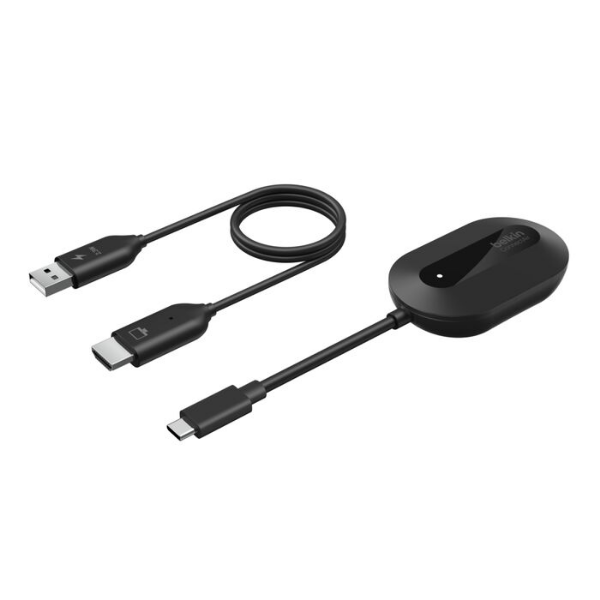
Best for: Cable-free screen sharing.
ConnectAir Wireless HDMI Display Adapter
- Plug-and-play with no WiFi, apps or drivers needed
- Mirror or extend your display in up to 1080p HD
- Long-range, low-latency performance for smooth streaming
| Feature | Streaming Stick | Wireless HDMI |
|---|---|---|
| Works on captive portal WiFi | No | N/A (no WiFi needed) |
| Works with locked-down hotel TVs | No | Yes |
| Requires app installation | Yes | No |
| Works with any USB-C laptop | No | Yes |
The Wireless HDMI Advantage for Travelers
Wireless HDMI bypasses both the hotel TV lockdown problem and the captive portal problem simultaneously. One manufacturer described the use case this way: "Unlike some 'wireless' systems that still rely on local Wi-Fi or phone tethering, [wireless HDMI] uses a direct signal between transmitter and receiver."
Because the connection is entirely self contained, it doesn't matter whether the hotel's WiFi requires authentication or whether the TV's software has been locked down. The receiver plugs into an HDMI port, the transmitter connects to your device, and the wireless link happens independently of any other infrastructure.
Product listings frequently highlight portability as a selling point. One wireless HDMI kit advertised: "Travel-Ready Design: Compact and lightweight, perfect for business trips or vacations. Enjoy movies without logging in to unfamiliar TVs."
That last point about not logging in to unfamiliar TVs resonates with security conscious travelers. Hotel smart TVs are not known for rigorous security practices, and entering streaming credentials on shared devices creates obvious risks.
Dual Purpose: Presentations and Entertainment
One manufacturer's marketing captured a sentiment that applies broadly to wireless HDMI: "After a long day of presenting, the same portable [device] that served you so well in conveying work content then reveals itself as a superb leisure partner."
A wireless HDMI adapter serves this dual role well. During working hours, it's presentation equipment that works with unfamiliar conference room setups. In the evening, it turns the hotel room TV into an extension of your laptop screen for entertainment. One device that solves two problems is an appealing value proposition for anyone trying to minimize what they carry.
Common Travel Scenarios
The following table summarizes common situations where wireless HDMI proves useful for business travelers:
| Scenario | The Problem | How Wireless HDMI Helps |
|---|---|---|
| Hotel room entertainment | TV inputs locked: captive portal WiFi blocks streaming sticks | Direct wireless connection required no network access |
| Client site presentation | Unknown equipment; wrong cables or adapters | Self-contained system works with any HDMI display |
| Extended stay or Airbnb | Unfamiliar TV setup; no access to streaming apps | Mirror your laptop with all your own content and accounts |
| Working from hotel room | Small laptop screen makes spreadsheets and documents hard to read | Use hotel TV as a second monitor for expanded workspace |
| International travel | Different plug types; voltage concerns with powered devices | USB powered from laptop or standard phone charger |
Part Three: Technical Questions and Realistic Expectations
Is Wireless HDMI Latency Noticeable for Presentations?
Latency concerns appear frequently in reviews and forum discussions. Based on our research, modern wireless HDMI adapters typically introduce delays in the range of 50 to 100 milliseconds. For presentations, video playback, and general productivity, this is imperceptible. For competitive gaming where frame timing matters, it's not acceptable.
Several product listings claim "near zero latency" or "less than 0.01 seconds," but these claims should be viewed skeptically. The physics of encoding, transmitting, and decoding video wirelessly impose inherent delays. What matters is whether those delays are noticeable for your intended use case, and for business applications, they generally aren't.
Resolution Limitations
Most consumer and prosumer wireless HDMI adapters max out at 1080p at 60Hz. Some accept 4K input but downscale for transmission. True wireless 4K at 60Hz requires significantly more expensive professional equipment.
For business presentations, this limitation rarely matters. PowerPoint slides, spreadsheets, and most video content look fine at 1080p. Most projectors in conference rooms are 1080p native anyway. The 4K limitation becomes relevant mainly for specialized use cases like video production or high end home theater, which aren't the primary market for portable wireless HDMI adapters.
HDCP and Streaming Content
HDCP (High bandwidth Digital Content Protection) compliance is a genuine concern for anyone planning to watch streaming services through a wireless HDMI connection. Netflix, Amazon Prime Video, Disney Plus, and similar services use HDCP to prevent unauthorized copying. If a wireless HDMI adapter doesn't properly support HDCP handshaking, protected content will display as a black screen.
One product listing was explicit about this limitation: "Non-HDCP video apps like YouTube, TikTok, and Zoom are supported on all operating systems; subscription-based HDCP apps like Netflix and Amazon Prime are supported only on Windows."
If streaming protected content is a priority, verify HDCP 2.2 compliance before purchasing, and test with your specific devices and services. This is an area where cheaper adapters frequently fall short.
Range and Obstruction
Typical wireless HDMI systems advertise ranges of 30 to 50 feet with clear line of sight. Walls and other obstructions reduce effective range significantly. For the use cases discussed here, specifically conference rooms and hotel rooms, range is rarely a practical limitation since you're typically in the same room as the display.
Longer range applications, like sending video between rooms or across large venues, require different (and more expensive) solutions designed for those scenarios.
Conclusions
Based on this research, wireless HDMI adapters solve genuine problems for two specific audiences:
For corporate users, they eliminate the cable management headaches that waste time at the start of meetings, simplify guest presenter access without creating security concerns, and clean up the aesthetics of professional meeting spaces. The technology is mature enough that reliability concerns, while understandable given early wireless display experiences, are largely addressed by current generation hardware.
For business travelers, they provide a way to actually use hotel room TVs that have been deliberately locked down, without depending on hotel WiFi infrastructure that creates its own problems. The dual use value, as both presentation equipment and personal entertainment, makes them worth the bag space.
What wireless HDMI isn't designed for is competitive gaming. It won't deliver true 4K at high refresh rates. HDCP compatibility varies and requires verification. But for the business use cases that drive most purchasing decisions, these limitations don't significantly diminish the value proposition.
The core appeal is simplicity: plug in two devices and they connect to each other, with no network configuration, no software installation, and no compatibility troubleshooting required. That's a compelling pitch for anyone who has spent too many meetings watching someone fumble with cables.
FAQs
Yes, as long as the port accepts signals physically, the ConnectAir Wireless HDMI Display Adapter bypasses software lockdowns.
No, the ConnectAir Wireless HDMI Display Adapter ConnectAir uses a direct 5GHz radio link independent of any network.
Yes, up to 8 transmitters can pair to a single receiver.
Under 80ms, imperceptible for slides, video, and general productivity.
ConnectAir is a proprietary derivative of Wi-Fi Direct with link‑layer encryption, suitable for room‑scale / nearby mirroring.