Premium accessories for iPhone 18. Shop now.


Wireless Car Chargers
Experience the convenience of our wireless car charger mounts, designed for iPhone, Samsung, and other Android devices. Enjoy fast, cable-free charging with auto-clamping technology for effortless phone alignment and removal. Our chargers ensure safe, reliable power on the go.
- Best Seller
- Featured
- Newest
- Price Low to High
- Price High to Low
https://www.belkin.com/uk/products/wireless-chargers/wireless-car-chargers/?start=0&sz=12



Wireless Car Chargers FAQ
A phone has a copper coil with is a receiver and the charger has a copper coil which is a transmitter, when they are aligned they create an electromagnetic field which allows power to pass through and recharge the devices battery.
Magnetic alignment works with phones that have a magnet ring built into the back, or with a Qi2-ready case on phones that don't. The current lineup:
Apple iPhone: iPhone 12 and later have built-in MagSafe magnets and snap directly to magnetic car mounts. iPhone Air, iPhone 17, 17 Pro, and 17 Pro Max are all included.
Samsung Galaxy: S25 and S26 series support the Qi2 magnetic profile but don't have built-in magnets. A Qi2-ready magnetic case adds snap-on alignment.
Google Pixel: Pixel 10, 10 Pro, and 10 Pro Fold have built-in Qi2 magnets and snap directly. Earlier Pixels need a Qi2-ready case.
Other Android phones: a Qi2-ready or MagSafe-compatible case adds magnetic mount support to any wireless-charging-capable phone.
Phones without wireless charging won't work with a wireless car charger mount; use a wired USB-C car charger instead.
For more, see our Qi2 compatible devices guide.
Once wireless charger is plugged into a power source, to charge your device all you need to do is place it down on top of the charger, making sure it’s cantered and charging will commence. Charging will be indicated by an Led light or animation on your phone screen.
No it is not.
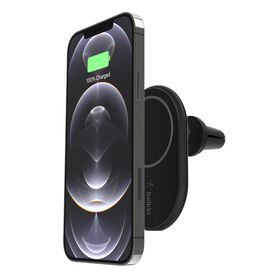
Yes, Belkin offers wireless car chargers with vent mount options. These chargers typically feature a clip that securely attaches to your car's air vent, providing a convenient way to charge your phone while driving without taking up space on your dashboard. Benefits include easy installation, adjustable viewing angle, wide compatibility, fast charging, and sturdy design. Belkin car chargers that feature the vent mount include:
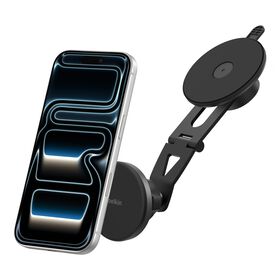
Belkin wireless car charger mounts are designed to be easy to install. Depending on the model, you can either clip it onto your car’s vent or attach it to the dashboard or windshield with suction cups or adhesive. No tools are required, and the process typically takes just a few minutes, making them convenient and user-friendly.
In most situations, yes. Standard wireless charging works through plastic, silicone, leather, and most non-metal cases up to about 3mm thick. Metal cases, thick rugged cases, or cases with magnetic wallet attachments behind the phone can block charging or weaken the magnetic snap.
For magnetic car mounts specifically, the case needs to be MagSafe-compatible or Qi2-ready (magnets embedded in the back). Without magnets, the mount may not hold the phone securely while driving. iPhone 12+ has built-in MagSafe magnets and works with most slim cases; Galaxy S25 / S26 needs a Qi2-ready case.
No. The magnets in MagSafe and Qi2 car chargers are weak alignment magnets, similar in strength to a fridge magnet. They don't affect car infotainment systems, dashboard sensors, GPS, or your phone's built-in compass for navigation. Apple Maps and Google Maps work normally with the phone mounted on a magnetic car charger.
The main consideration is mounting placement: avoid placing a magnetic car charger directly over an airbag deployment zone or in a position that obstructs your view of the road.
Wireless car charger speed depends on the charger spec, the phone, and the car's USB power output:
- Standard Qi car charger: up to 5W
- 10W / 15W Qi car charger: up to 10-15W on Galaxy and Pixel; 7.5W on iPhone (no magnet)
- MagSafe / Qi2 car charger: up to 15W on iPhone 12+, Galaxy S25 / S26, Pixel 10
- Qi2 25W car chargers (when available): up to 25W on iPhone 16 and later
Most car USB outlets deliver 12-15W of power, which is enough for full wireless speed. Some cars with higher-wattage USB-C ports (45W+) can power Qi2 25W charging at full speed. If charging is slow, check the cable that came with your car charger and the USB port wattage rating.

Welcome. Would you like to be redirected to the Belkin US website?
United States