Festival-Ready? Unlock up to 18% off everything. Save now.


Wireless Chargers,
Charging Pads & Stations
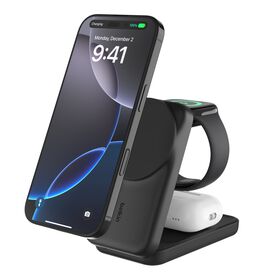
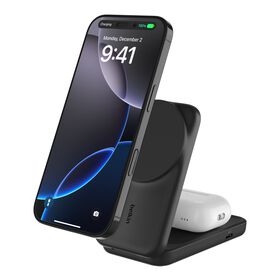
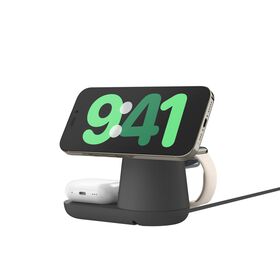
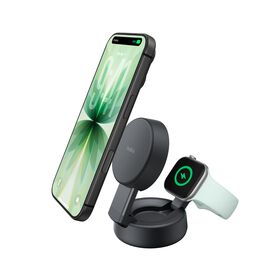
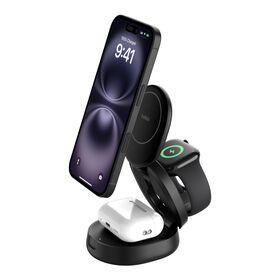
Discover wireless chargers compatible with Apple and Samsung devices including iPhones, AirPods, Apple Watch, and Samsung Galaxy. Explore 3-in-1 charging stands and pads, along with 2-in-1 chargers ideal for home, office, and travel.
Sort by
https://www.belkin.com/uk/products/wireless-chargers/?start=0&sz=12









Wireless Charger FAQ
A phone has a copper coil with is a receiver and the charger has a copper coil which is a transmitter, when they are aligned they create an electromagnetic field which allows power to pass through and recharge the devices battery.
No it is not.
Apple devices: every iPhone since iPhone 8 (2017), including iPhone Air, iPhone 17, 17 Pro, and 17 Pro Max. iPhone 12 and later add MagSafe magnetic alignment. iPhone 16 and 17 series support Qi2 25W speeds with a Qi2 25W certified charger.
Samsung Galaxy: every Galaxy S series flagship from S6 onward (S6 through S26), every Galaxy Note from Note 5 on, and the Galaxy Z Fold and Z Flip foldables. The S25 and S26 series support native Qi2 charging. The S26 Ultra reaches 25W with a Qi2 25W charger (S26+ at 20W, S26 at 15W).
Google Pixel devices: Pixel 3 through Pixel 10 series, including Pro and Pro XL variants. Pixel 10, 10 Pro, and 10 Pro Fold add built-in Qi2 magnets. Pixel 10 Pro XL reaches 25W on a Qi2 25W charger.
Other Android: OnePlus 13 and HMD Skyline support Qi2 at 15W. Most other Qi-enabled Androids work at 5-7.5W on a standard Qi pad.
Once wireless charger is plugged into a power source, to charge your device all you need to do is place it down on top of the charger, making sure it’s cantered and charging will commence. Charging will be indicated by an Led light or animation on your phone screen.
Wireless charging stands are similar to charging pads, but hold the device at an angle so it can be viewed while it charges. They work by using inductive charging, which transfers energy wirelessly from the charger to the device being charged. The charger contains a coil of wire that creates an electromagnetic field, and the device being charged contains a coil that picks up this field to charge the battery. Most charging stands use the Qi standard, which optimizes the charging process by adjusting power and speed, and the device can be used and viewed while it charges.
Most modern iPhones come with wireless charging capabilities. Here’s a quick rundown of the iPhone models that support this feature:
- iPhone 8 and later: All models from the iPhone 8 onwards support wireless charging.
- iPhone X and later: This includes the iPhone X, XS, XS Max, XR, and newer models.
- iPhone 11 series: All models, including iPhone 11, 11 Pro, and 11 Pro Max.
- iPhone 12 series: All models, including iPhone 12, 12 mini, 12 Pro, and 12 Pro Max. These also support MagSafe wireless charging.
- iPhone 13 series: All models, including iPhone 13, 13 mini, 13 Pro, and 13 Pro Max, also support MagSafe.
- iPhone 14 series: All models, including iPhone 14, 14 Plus, 14 Pro, and 14 Pro Max, continue to support MagSafe.
- iPhone 15 series: All models, including iPhone 15, 15 Plus, 15 Pro, and 15 Pro Max, continue to support MagSafe.
- iPhone 16 series: All models, including iPhone 16, 16 Plus, 16 Pro, and 16 Pro Max, continue to support MagSafe.
Yes, many Samsung phones support wireless charging. Here’s a breakdown of Samsung models that generally support wireless charging:
- Galaxy S Series: Galaxy S6 and later: Starting with the Galaxy S6, all models including S6 Edge, S7, S7 Edge, S8, S8+, S9, S9+, S10e, S10, S10+, S20, S20+, S21, S21 Ultra, S22, S22+, S22 Ultra, S23, S23+, and S23 Ultra support wireless charging.
- Galaxy Note Series: Galaxy Note 5 and later: All models including Note 8, Note 9, Note 10, Note 10+, Note 20, and Note 20 Ultra have wireless charging capabilities.
- Galaxy Z Series: Galaxy Z Fold and Z Flip series: Models such as the Galaxy Z Fold 2, Z Fold 3, Z Fold 4, Z Flip, Z Flip 5, and their subsequent models support wireless charging.
- Galaxy A Series: Select models: Some of the higher-end Galaxy A series models, like the Galaxy A80, A90, and A91, support wireless charging, but many of the mid-range models do not.
- Galaxy M Series: Limited support: Generally, the Galaxy M series, which is more budget-focused, does not include wireless charging in its models.
Yes, many Android phones support wireless charging. The feature is common in mid-range to high-end models. Here’s a breakdown of Android phones with wireless charging:
- Google Pixel Series: Pixel 3 and later: All Pixel models from the Pixel 3, Pixel 3 XL, Pixel 4, Pixel 4 XL, Pixel 5, Pixel 6, Pixel 6 Pro, Pixel 7, and Pixel 7 Pro support wireless charging.
- Samsung Galaxy Series: Galaxy S Series: Starting with the Galaxy S6, most models in the S series support wireless charging.
- Galaxy Note Series: From the Note 5 and later, including the Note 20 Ultra.
- Galaxy Z Series: Includes various models such as the Galaxy Z Fold and Z Flip series.
- OnePlus: OnePlus 8 Pro and later: The OnePlus 8 Pro, OnePlus 9 Pro, and OnePlus 10 Pro support wireless charging. Some earlier models do not.
- Xiaomi: Mi Mix 4 and later: The Mi Mix 4 and some other higher-end models, like the Mi 11 and Mi 11 Ultra, support wireless charging.
- Sony: Xperia 1 and later: Models like the Xperia 1 II, Xperia 1 III, and newer Xperia phones support wireless charging.
- Oppo: Find X Series: Models like the Oppo Find X3 Pro support wireless charging.
- Huawei: P40 Pro and later: The Huawei P40 Pro, Mate 40 Pro, and similar high-end models support wireless charging.
- Other Brands: LG: Some models like the LG V30, V35, V40, and G7 ThinQ support wireless charging, though LG has exited the smartphone market. Asus: Select models such as the ROG Phone 5 support wireless charging.
When comparing wireless chargers for iPhones and Samsung phones, there are several factors to consider, including compatibility, charging speed, design, and additional features. Here’s a breakdown of what to look for:
1. Compatibility
- iPhones: Qi Standard and MagSafe (for iPhone 12 and later). MagSafe offers better alignment and up to 15W charging.
- Samsung Phones: Qi Standard. Most models support up to 10W, with some supporting up to 15W fast wireless charging with Samsung's chargers.
2. Charging Speed
- iPhones: Up to 7.5W on standard Qi chargers. Up to 15W with MagSafe.
- Samsung Phones: Up to 10W on standard Qi chargers. Up to 15W with Samsung’s fast wireless chargers.
3. Design and Features
- iPhone MagSafe Chargers: Magnetic alignment, sleek design, integrates with MagSafe accessories.
- Samsung Wireless Chargers: Various designs (pads and stands), some with additional features like cooling fans, and the ability to charge multiple devices simultaneously.
4. Price
- MagSafe Chargers: Generally higher-priced due to proprietary technology.
- Samsung Wireless Chargers: Variable pricing; often competitively priced with additional features available.
Fast wireless chargers can vary depending on the device and the charger used. Here’s a general overview:
1. Standard Wireless Charging
- iPhones: Up to 7.5W using Qi-compatible chargers.
- Samsung Phones: Typically up to 10W using Qi-compatible chargers, though some models support more.
2. Fast Wireless Charging
- iPhones: Up to 15W with Apple’s MagSafe chargers for iPhone 12 and later.
- Samsung Phones: Up to 15W with Samsung’s proprietary fast wireless chargers, like those for the Galaxy S21 Ultra or Note 20 Ultra.
Charging Speed Summary
- iPhone Standard: 7.5W
- iPhone MagSafe: Up to 15W
- Samsung Standard: Up to 10W
- Samsung Fast Charging: Up to 15W
Note: The actual charging speed can be affected by factors such as phone case thickness, alignment on the charger, and the charger's power output. Learn more about fast wireless charging.

Welcome. Would you like to be redirected to the Belkin US website?
United States